
Introduction: The Search Landscape Has Fundamentally Changed
Search is undergoing the most significant transformation since Google’s inception. For over two decades, digital visibility depended solely on Search Engine Optimization (SEO)—ranking web pages on search engines like Google and Bing. Today, however, users increasingly receive answers directly from AI systems such as ChatGPT, Google Gemini, Microsoft Copilot, and Perplexity. Instead of showing ten blue links, these systems generate direct answers synthesized from multiple sources.
This shift has created a new optimization discipline that combines SEO, AEO (Answer Engine Optimization), GEO (Generative Engine Optimization), and LLMO (Large Language Model Optimization). Together, these strategies determine whether your content becomes part of the AI knowledge layer powering modern search.
Part 1: Understanding the Four Pillars of Modern SEO
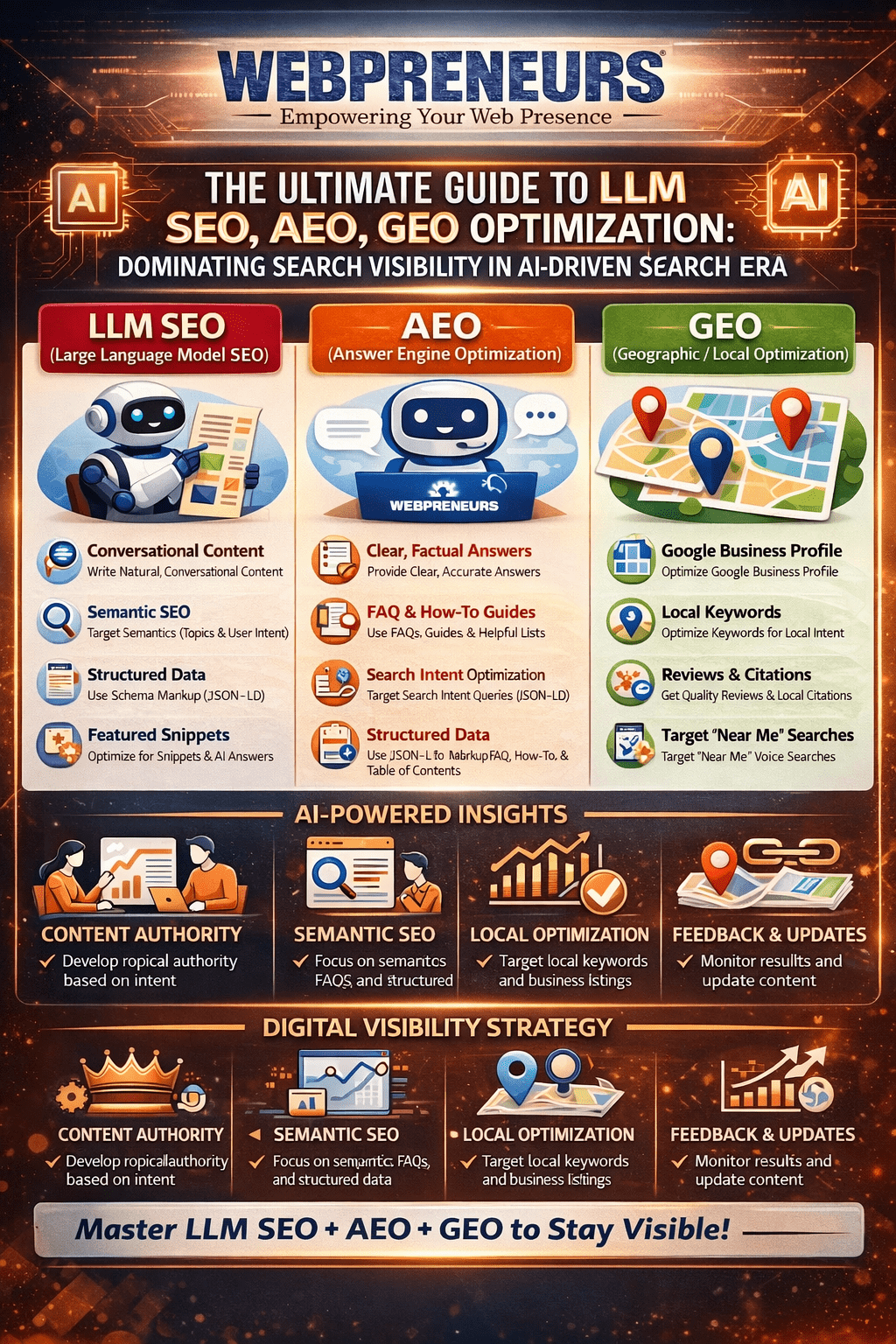
1.SEO (Search Engine Optimization) – The Foundation That Still Matters
The practice of optimizing web pages to rank higher in traditional search engine results using keywords, backlinks, technical structure, and relevance signals.
Why it still matters:
Search engines like Google continue to crawl and index billions of pages. Most AI systems still rely on traditional search engine indexes to discover and retrieve information. Strong SEO ensures your content can be discovered in the first place.
Key Focus Areas:
- Technical SEO: Site structure, crawlability, page speed, mobile usability
- On-page SEO: Keywords, headings, metadata, internal linking
- Off-page SEO: Backlinks, domain authority, brand signals Content quality: Depth, relevance, and originality
- Content quality: Depth, relevance, and originality
2.AEO (Answer Engine Optimization) – Getting Direct Answers in Search
Structuring content to provide direct, concise answers that AI-powered tools and featured snippets can extract and display.
Best Practices:
- Answer questions directly
- Use question-based headings
- Format content for scannability
- Include statistics and data
- Add FAQ schema markup
3.GEO (Generative Engine Optimization) – Being Cited by AI Summaries
Structuring content so it gets included in AI-generated summaries.
Strategies:
- Build topic clusters
- Create atomic pages
- Ensure semantic completeness
- Make content citation-worthy
4. LLMO (Large Language Model Optimization) – The Foundation Layer
Preparing your content so AI systems can ingest and accurately represent your information.
Key Components:
- Entity recognition
- Semantic structure
- Terminology consistency
- Multi-platform coherence
As businesses adapt to this evolving search landscape, implementing SEO, AEO, GEO, and LLMO together requires both strategic clarity and technical precision. Many organizations partner with experienced teams like Webpreneurs (Greater Noida, India) to streamline execution and stay ahead in AI-driven search visibility.
Part 2: The Four-Layer Strategy – How They Work Together
- SEO helps discovery AEO helps extraction
- GEO helps summarization LLMO ensures accurate retrieval
Part 3: Implementing a Comprehensive Optimization Strategy
- Step 1: Audit your brand across AI platforms
- Step 2: Build content architecture and topic clusters Step 3: Optimize for AEO
- Step 4: Build authority for GEO
- Step 5: Implement LLMO foundation
Part 4: Content Best Practices for the AI Era
- Be clear and declarative
- Use structured formatting
- Focus on one concept per page
- Keep content updated
Part 5: Common Mistakes to Avoid
- Ignoring SEO
- Creating AI-only content
- Lack of consistency
- Skipping structured data
- Outdated content
Part 6: The Future of Search Visibility
Search is now AI-driven and conversational. Businesses optimizing across all four pillars will dominate future visibility.
Conclusion
In 2026 and beyond, digital visibility isn’t just about rankings—it’s about being discoverable, understandable, citable, and accurately retrieved across AI ecosystems.
As the search ecosystem continues to evolve, businesses that proactively adapt will gain a clear competitive edge. Whether you’re starting or scaling, consulting with experts in AI-focused optimization—like Webpreneurs—can help you move faster and more effectively